
With a foggy haze and a pounding headache, I’m seated at my desk studying my entire Biology course for my final tomorrow. I read my notes “the boraifhn is the axlcmfn organ in the human body due to its fjxncbfh”. I seek my only friend during this study session – coffee. I take a big gulp, hoping the caffeine can rejuvenate me. It’s tepid and has far too much cream for my liking but hey! It’s coffee and it’s 2AM. A girl’s gotta do what a girl’s gotta do. 100 pages left to memorize. There’s no way I pass this test. My phone vibrates. A text from my friend, Melissa: “had an amazing time last night! So happy you decided to come out with us!”. My ringing ears and uncontrollable yawns suggest that maybe going out wasn’t one of my brightest ideas. I knew I had this major biology test to study for and going out would only lead to future stress. I’m a smart girl. So why did I do it?
Let me introduce you to a concept we probably all know far too well: self-sabotage. Ah the beauty of knowing you’re doing something wrong, but you do it anyways! It’s like when we know we have to wake up at 7am the next morning to get our lazy asses to school, but we decide to pull an all-nighter. We know that is most definitely the worst possible decision we can make, but it doesn’t stop us from staying up all night binge-watching Friends on Netflix while shoving our faces with popcorn and M&Ms.
I’ve come to learn that there are actually many psychological explanations as to why we engage in self-sabotage, some of which are shocking. According to Ph.D Ellen Hendrisken in her Psychology Today article titled “Why Do We Self-Sabotage?”, we all want control. Even if you know you’re about to do something wrong, it’s nice to know it is you who is making that decision, and not somebody else. Last year I went out for a night of drinking and fun (or so I thought) to celebrate my friend’s 18th birthday. I was actually having a pretty good time until Sarah, the birthday girl herself, pulls me aside sobbing hysterically. I’m talking the whole shebang: runny nose, hyperventilating and black mascara dripping down her face. Although I’m sure the fact that Sarah was nearly too drunk to walk played a role in her endless pool of tears, she tells me that she broke up with Chad (aka her long-time boyfriend of a whole one month). She says things started to get a bit rocky between them and she wanted to be the one to call things off before he did. I nearly laughed in her face! Why would she break up with her boyfriend when she’s not certain that he would break up with her? It all seemed too much for me to handle and the stench of Grey Goose pouring out of Sarah’s breath was no sign that she was clear-headed enough to be having this discussion on the dance floor of a nightclub. I suppose Hendrisken is right in suggesting that we as individuals feel as though it’s better to screw ourselves over because at least we are the ones in control.
I’m sure we’ve all heard the phrase, “sleep is for the weak”. I always found it funny because those who actually believe it are probably the most sleep deprived, cranky and unmotivated people to exist. The Centers for Disease Control and Prevention demonstrates that 70% of high school students don’t get enough sleep. I can’t think of one friend at the top of my head who succeeds in getting 8-10 hours of sleep every night. On a good day, I’ll get 9 hours of sleep and I feel like a new woman. I’m like Sleeping Beauty who just awoke from her slumber to find her prince hovering over her. Free of pounding headaches and an irritable mood, I’ll make my way to my Keurig to fix up a hot coffee. Not because I need it, but because I want it. Next, I’ll make myself a delicious breakfast: eggs cooking on the stove and toast burning in the toaster – a gourmet meal made by yours truly. I’ll then go to eat it in my room while I get started on completing any homework or assignments I have for that day. Now, it may seem like that morning routine is taken from a Disney fairy tale, but I swear some people are actually able to wake up feeling rejuvenated and are productive with their lives! I know, what a concept.
Lauren F. Friedman calls the non-sleeping beauties of our world “sleepless sufferers”. In case the name isn’t self-explanatory, that basically involves anyone who has difficulty getting into bed. Let’s not forget about the “bedtime procrastinators” which are people who are tired and know they should be in bed, but are pre-occupied doing other tasks. Nothing is really preventing bedtime procrastinators to go to sleep since they are choosing to do other things rather than sleeping. Researcher Joel Anderson poses an important question: “why is it that people fail to do what they know is good for them to do?”. Often individuals procrastinate undesirable tasks (such as doing homework), but sleep is usually desirable because it makes us feel good. Therefore, why do we put it off? If I’m being honest here, I’m not totally sure how to answer Anderson’s question. Because if I knew, I wouldn’t be sitting here working on this feature story at 3 in the morning.
In all seriousness though, this question has been haunting me. I love sleep. I’m like a sloth. If it were up to me, I would sleep all hours of the day. So why do I resort to staying up all night and depriving myself of something I love? If you ask me, it all comes back to the same explanation: self-sabotage. I know I should sleep. I know I’ll hate myself the next morning for clicking “play next episode” on my Netflix account at 2AM… but I do it anyways. It’s almost as if I can’t help myself. It feels like a subconscious effort. By binge-watching TV during all hours of the night, I’m not actively thinking “I’m watching TV to make myself miserable and exhausted tomorrow”. It just happens. And quite frankly, I’m sick of it. So, have no fear, I’ve discovered some ways to be more aware of our self-sabotaging behaviors as well as some ways to potentially stop them all together.
Effectivology’s article titled, “Carpe Diem: Seize the Day” introduces the key to our problem: carpe diem. It’s a Latin phrase which encourages individuals to stay present in the moment, to appreciate the things we have and to never procrastinate doing what we want because our time is limited. I know, it’s cheezy and honestly a bit morbid to think that life can end at any moment. However, it truly did give me a new perspective on how to live my life. It reminds me of an experience I had in early winter 2019 with my psychologist: in the room hangs abstract art. I look at the drawings and see nothing but everything all at once. I sink into the cushions on the faux-leather couch. My psychologist tells me to close my eyes. She begins telling me to focus on my breath, to be present in this moment. Her voice eventually fades and I’m left alone with my body floating in time and space. I hear the clock ticking. I feel my shoulders loosening. I see darkness with a hint of light peering through my closed eye lids. I taste the tuna I had for lunch. I open my eyes to see my psychologist looking back at me. I feel good. I feel powerful. All my anxieties and overwhelming thoughts melt away. I stand up from the couch and feel weightless, like a bag floating in the air being carried by the wind. I’m ready to take on the day. Taking a step back and allowing myself to just be in the present moment made me realize that I need to be kinder to myself and to look out for my future self. Again, I know, it’s super cheezy but just ignore your lactose-intolerance and give the cheese a chance.
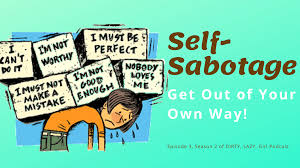
It’s important to stop blaming ourselves for things which are out of our control, but to start holding ourselves accountable and owning up to our mistakes. An article by Elizabeth Howes titled “Why We Turn to Self-Blame and How to Release Ourselves From It” explains that our limbic system, which controls our emotional and behavioral responses, has self-deprecation fixed into our nervous system. Thoughts such as “I’m not good enough” or “everybody hates me” are easily triggered by our limbic system. By looking at those thoughts as stories our brain tells us, we can learn to live peacefully with them. Some thoughts are positive, some are negative. It is okay to have those negative thoughts, but it’s crucial to learn how to properly respond to them. By freeing ourselves from our negative thoughts, we can free ourselves from our self-sabotaging behaviors. By thinking we are worthless, we give permission to screw ourselves over. Look at your life as a TV. There’s multiple channels. Each channel has a different show which tells a different story. You hold the remote. You decide which show you want to partake in. You don’t like the episode? Change the channel. You control your thoughts. You control your actions. Nobody else.
It’s 11pm. I close my biology textbook feeling anxious yet confident for my final tomorrow. I change into my pyjamas and crawl into my bed. It’s warm and inviting. I sink into my pillow and recognize my anxious thoughts, but I do not let them tear me down. Whatever happens tomorrow will happen. I know I did all that I could and that’s all that matters. With a clear mind, I close my eyes and drift into sleep.
Works Cited
“Carpe Diem: Seize The Day.” Effectiviology.com. N.p., 2020. Web. Retrieved 28 Apr. 2020.
Friedman, Lauren F. “This Is Why You Stay Awake All Night When You Know You Need To Sleep.” Business Insider,18 June 2014.
Hendriksen, Ellen. “Why Do We Self-Sabotage?” Psychology Today, Sussex Publishers, 10 Oct. 2017.
Howes, Elizabeth. “Why We Turn to Self-Blame and How to Release Ourselves From It.” Torch, 2 Oct. 2019.
Wheaton, A., Jones, S., Cooper, A., & Croft, J. (2020). Short Sleep Duration Among Middle School and High School Students — United States, 2015.
 Rachel's Nonfiction Blog
Just so great. The version I read was already close to this, so I’ve commented on it with you in person. But it’s so great. Here’s what I love about it.
1) You identify your voice as something you’re proud of. You should be. It’s a real achievement. It’s personable, funny, but also sensitive and vulnerable. Really strong. It carries this piece.
2) You move through a really fascinating journey of bigger picture ideas.
3) You’re really thinking about what you’re writing, your sources, your research. You’re putting a puzzle together. That’s what it feels.
4) The ending is pretty great, I have to say. The teacher in me wants to give you suggestions for how to improve it. But, the reader in me feels like it’s pretty perfect. Caps off the journey nicely.
What’s left to do for the final draft?
1) A good title.
2) Condensing a few parts. I honestly only had one suggestion of one line to cut.
3) Possibly fix up some of the transitions?
Not much, to be honest. You’re very close to a final draft here. Awesome!
I put a few notes on your Word copy, which I’ll upload to LEA today.
Sleep well tonight knowing that you’ve done a first rate job on this draft.
LikeLike